Quick Summary - AI-powered bag counting doesn't need perfect bags to deliver perfect counts. From torn and crushed to overlapping and misshapen, AI vision systems handle real industrial conditions, dust, low light, night shifts, where sensor-based counters and human tallies consistently fail.
Here is a question nobody in the industry asks out loud, but every plant manager has thought about: What happens to your bag count when reality kicks in?
Not the clean, evenly spaced, perfectly sealed bags running on a lab-grade conveyor. The real ones, the bag that got caught under a pallet, the one that arrived at the loading bay half deflated, the two that stuck together in the humidity, and the torn one leaking powder all over the belt. These are not edge cases. These are on Tuesday morning at your plant.
Traditional counting systems, whether manual or sensor-based, were never built for this version of reality. They were built for an idealised version of it. And the gap between those two versions is exactly where your counting errors live.
This article answers the question directly: Can AI-powered bag counting handle torn, crushed, and misshapen bags in real industrial environments? And more importantly, how?
Why the Plant Floor Is Nothing Like a Lab
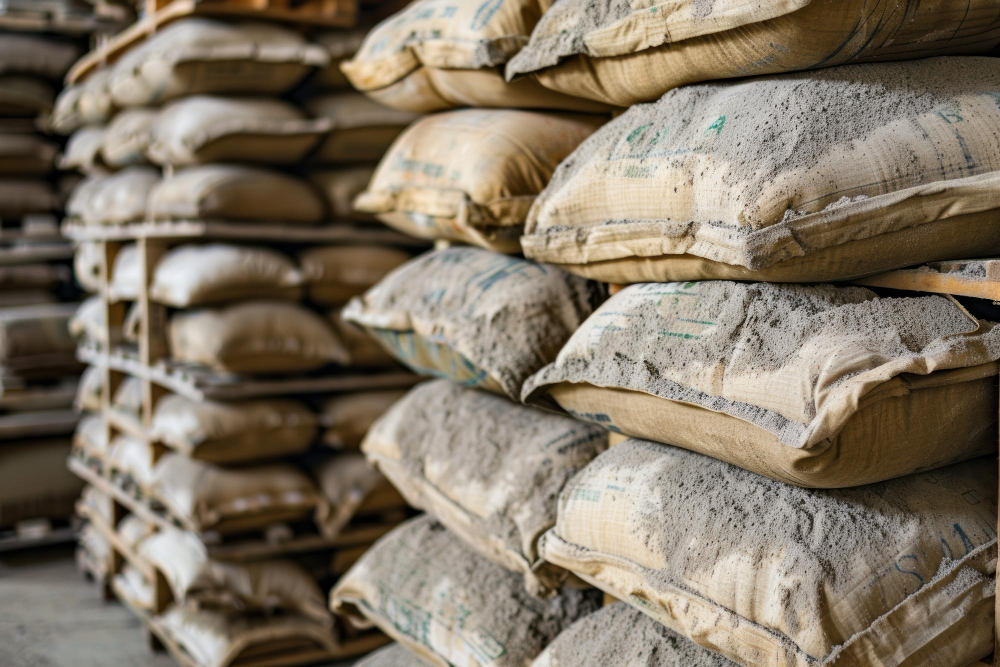
Walk into a cement packing plant, a fertiliser dispatch unit, or a food grain warehouse during peak dispatch hours, and you will understand immediately why counting is a hard problem.
Dust hangs in the air thick enough to cut visibility. The lighting shifts between floodlit zones and shadows cast by machinery. Bags come off the packing line at speeds that leave no margin for hesitation. Some bags are perfectly formed. Others arrive at the conveyor already compromised, slightly torn at the seam, pinched at the top, bulging unevenly because of inconsistent fill.
And none of this stops for your counting system to catch up.
This is the operating environment that industrial AI has to work in. Not a controlled research setting. A dusty, noisy, fast-moving plant floor where the conditions change by shift, by season, and by product line.
The honest answer to whether AI can handle it begins with understanding what AI actually sees, and what it is trained to see.
What a Sensor Sees vs. What AI Sees
A sensor-based counting system is fundamentally reactive. It waits for an object to cross its beam, interrupt its signal, or trigger its threshold. The moment that the signal fires, the counter increments.
This works perfectly when bags are uniform, well-spaced, and properly sealed. It starts failing the moment those conditions are not met. A torn bag that has partially collapsed may not have enough physical mass to trigger the sensor reliably. Two bags that have stuck together read as one object. A bag riding at an angle misses the detection window. A burst bag leaves residue on the sensor lens over time and begins generating false counts.
The sensor is not wrong, it is just doing exactly what it was designed to do. The problem is that what it was designed to do is not enough.
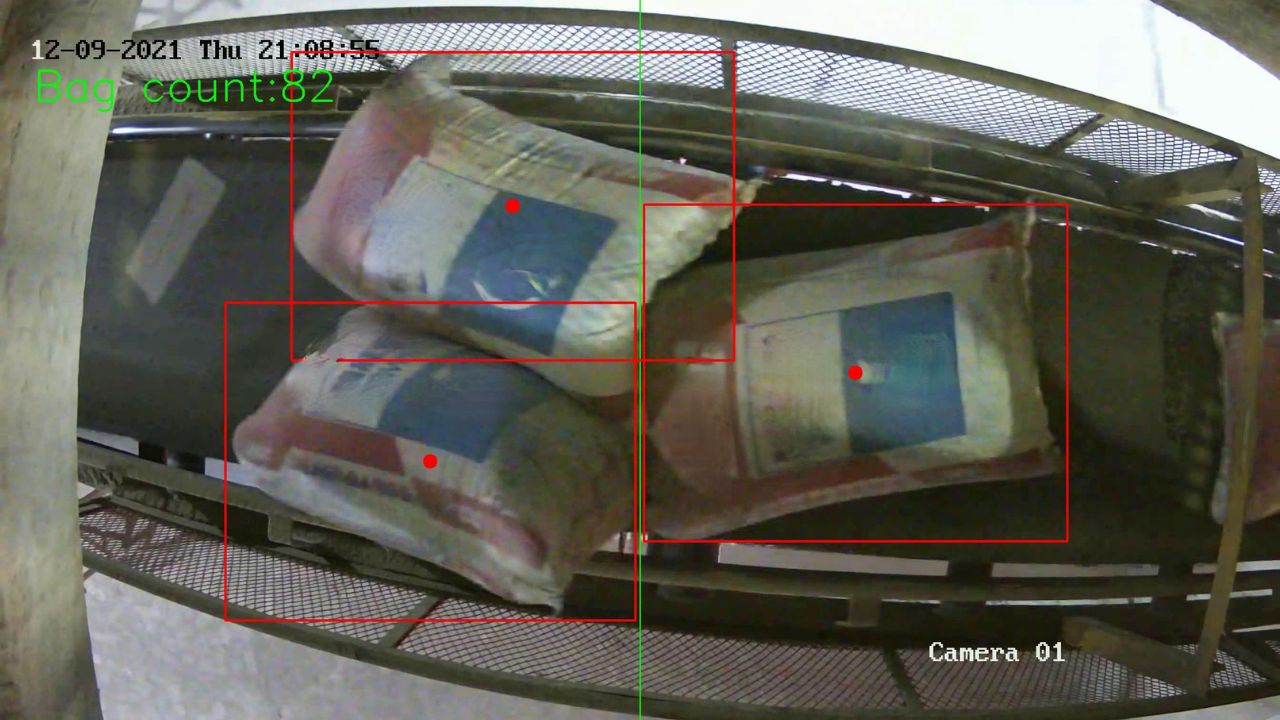
AI vision-based bag counting works differently at a fundamental level. Instead of waiting for a signal, it processes the entire visual scene. A camera positioned above the conveyor sends a continuous video stream to a deep learning model that has been trained on thousands of real bag images, in various states of damage, deformation, and orientation.
The model does not look for a signal. It looks for a bag. And it has learned what bags look like in every condition your plant produces.
How AI Handles the Hard Cases
Torn Bags
A torn bag is still a bag. It has shape, texture, mass, and movement. A trained computer vision model recognises these characteristics because it has been exposed to torn bags during training. The system draws an object boundary around the bag based on its visual profile, not its structural integrity. Whether the bag is leaking powder, partially open, or missing a corner, the AI identifies it as a countable object and tracks it across the counting line.
Crushed or Flattened Bags
Bags that have been compressed, by stacking, by machinery contact, or by being loaded at inconsistent fill levels, present a different shape profile than a full, upright bag. A sensor may miss or double-count these depending on their height and mass. AI instance segmentation handles this by evaluating the two-dimensional footprint of the bag in the camera frame, not just its height or mass. A flat bag still has a recognisable outline, and the model counts it accordingly.
Overlapping or Touching Bags
This is the failure mode that causes the most counting errors in high-speed dispatch environments. Two bags that arrive simultaneously or slide into contact on the belt look like one object to a sensor. To an AI object detection model, they are two distinct outlines. The model separates them, assigns each a unique identity, and counts both individually, even when they are partially obscured by each other.
Misshapen or Irregularly Filled Bags
A bag that was filled at 48kg instead of 50kg, or one that was sealed at an odd angle, does not look like the standard reference shape. Sensor-based systems calibrated to a specific bag profile can miss these. AI systems trained on real production data recognise irregular shapes as variations of the same object, not as unknown anomalies.
The Dust Problem — And How AI Solves It
Dust is the biggest environmental challenge in any heavy industry or construction application. In cement plants, especially, particulate matter settles on every surface within hours. A sensor lens covered in cement dust is a compromised sensor. A camera lens covered in dust is also a problem, but it is a solvable one.
Industrial-grade AI vision systems used in plant environments are built with dust-proof housings, positive-pressure enclosures that prevent particulate ingress, and in some configurations, dual-mode visible and thermal feeds that maintain real-time detection capability in heavy dust zones where visible light alone becomes insufficient.
The deep learning models powering these systems are also trained specifically on dusty, low-contrast, low-light footage, not clean studio images. This means the model has already learned to identify bags through haze, through variable illumination, and through the visual noise that characterises a real plant environment.
The Night Shift Problem Nobody Talks About
Plant operations do not pause at sunset. Dispatch runs across shifts. And night shift counting is where manual and sensor-based systems fail most consistently.
Human counters on a night shift deal with fatigue, reduced visibility, and the monotony of counting that makes attention drift inevitable. Research consistently shows manual counting accuracy drops significantly during late-night and early-morning shifts, the same windows that tend to see the highest incidence of pilferage and untracked losses.
Sensor systems are not affected by fatigue, but they are affected by the environmental conditions of night shifts, temperature changes that affect sensor calibration, lighting inconsistencies that create detection shadows, and belt speed variations that outpace sensor response times.
AI vision systems operate identically across all shifts. The model does not tire. It does not drift. It processes each frame at the same accuracy level at 3 am as it does at 3 pm. Combined with infrared-capable cameras that maintain visual clarity in low-light conditions, AI counting becomes more reliable precisely when human and sensor-based alternatives are at their weakest.
Why This Matters for Your Dispatch Numbers
Every bag your counting system misidentifies, whether it is a torn bag that gets skipped, two overlapping bags that count as one, or a crushed bag that falls below the sensor threshold, is an error that compounds downstream.
A short count at dispatch becomes a customer complaint. A double count becomes a billing dispute. A missed bag becomes an untracked loss that nobody can trace because there is no audit trail, just a number that does not match what arrived at the destination.
The cumulative financial impact of counting errors across a year of operations is rarely measured directly because most plants have no clean baseline to measure against. The moment you deploy a system that generates a verifiable, timestamped record of every bag — in every condition, you start to see the true scale of what inaccuracy was costing you.
How Helious Tech Solutions Handles the Real World
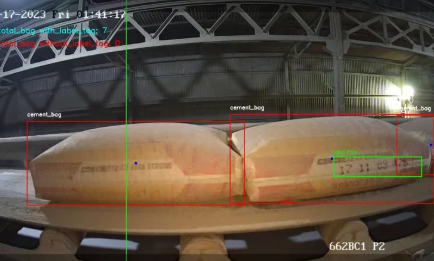
Helious Tech Solutions built its AI-Powered Bag Counting System specifically for the operating conditions described in this article, not for ideal ones.
Here is what that means in practice:
Trained on real industrial data. The Helious AI models are trained on footage from actual plant floors, cement, fertiliser, food grain, and chemical dispatch environments. The training data includes torn bags, overlapping bags, dusty conditions, variable lighting, and high belt speeds. The model has already seen your worst conditions before it ever goes live in your plant.
Dust-hardened camera hardware. Helious deployments use industrial-grade camera enclosures designed for the harshest plant environments, protecting lens integrity in high-particulate zones and maintaining image quality across shifts.
Real-time anomaly alerts. When the system detects a counting discrepancy, bags below threshold, unusual object on the belt, or a significant deviation from expected count, it sends an instant alert to the supervisor. Not at the end of the shift. In the moment.
Tamper-proof video audit trail. Every count is backed by a timestamped video record. When a distributor disputes a delivery quantity, you share footage, not a spreadsheet argument. Disputes are resolved faster, and accountability is built into every transaction.
Seamless ERP and WMS integration. Count data flows directly into your inventory management system and updates dispatch records in real time, eliminating the manual reconciliation step that introduces its own layer of human error.
Multi-industry adaptability. Whether you are counting 50kg cement bags, 25kg fertiliser sacks, or woven grain bags, the Helious system is configured and trained for your specific bag type. Switching products? The model retrains without touching the hardware.
The Bottom Line
The question was: can AI count torn, crushed, and misshapen bags in real industrial conditions?
The answer is yes, and it does it more reliably than any sensor or human counter operating in the same environment. Because AI vision-based bag counting does not depend on the bag being perfect. It depends on the bag being visible. And even visibility, in dust and low light, is a problem modern industrial AI has already solved.
If your current counting system only works when conditions are ideal, it is not working when it matters most.
Helious Tech Solutions gives your plant a counting system that was built for the real world, torn bags, night shifts, dusty lenses, and all.
Want to see how Helious performs in your plant's specific conditions? Request a live demo and deployment assessment from the Helious team today.
Frequently Asked Questions
Q1. Can AI bag counting systems accurately count torn or damaged bags on a fast-moving conveyor?
Yes. AI vision systems are trained on real industrial footage, including torn, deflated, and damaged bags. The model recognises each bag by its visual profile, not its structural integrity, ensuring accurate counts regardless of bag condition or conveyor speed.
Q2. How does AI bag counting perform in dusty environments like cement or fertiliser plants?
Industrial-grade AI cameras are housed in dust-proof enclosures and trained specifically on footage from dusty plant environments. Deep learning models adjust to low-contrast, hazy conditions, maintaining counting accuracy even in the heaviest particulate zones where sensors and human counters typically fail.
Q3. What happens when two bags overlap or stick together on the belt, does the AI count them as one?
No. AI instance segmentation draws individual boundaries around each bag in the camera frame, separating overlapping objects even at high belt speeds. Each bag is assigned a unique identity and tracked independently, something sensor-based systems fundamentally cannot do.
Q4. Does the AI bag counting system work consistently on night shifts and in low-light conditions?
Absolutely. AI vision systems with infrared-capable cameras maintain detection accuracy in low-light and night-shift conditions. Unlike human counters affected by fatigue or sensors impacted by temperature changes, the AI model performs identically across every shift, 24 hours a day.
Q5. What if a bag is not a standard shape or size, will the AI still count it correctly?
Yes. AI models trained on real production data recognise shape variations as normal, not anomalies. Irregularly filled, misshapen, or unevenly sealed bags are counted accurately because the model has learned what bags look like across every realistic variation your production line produces.